 Русский
 English
 Español

MAVATO / Portugal
A property shortlist in Portugal
Leave your phone number. We will discuss your plans and prepare a personal shortlist.
 Sign in / Register
Original published Mavato text. Migrated on 07.11.2026; terms must be checked at the time of enquiry.
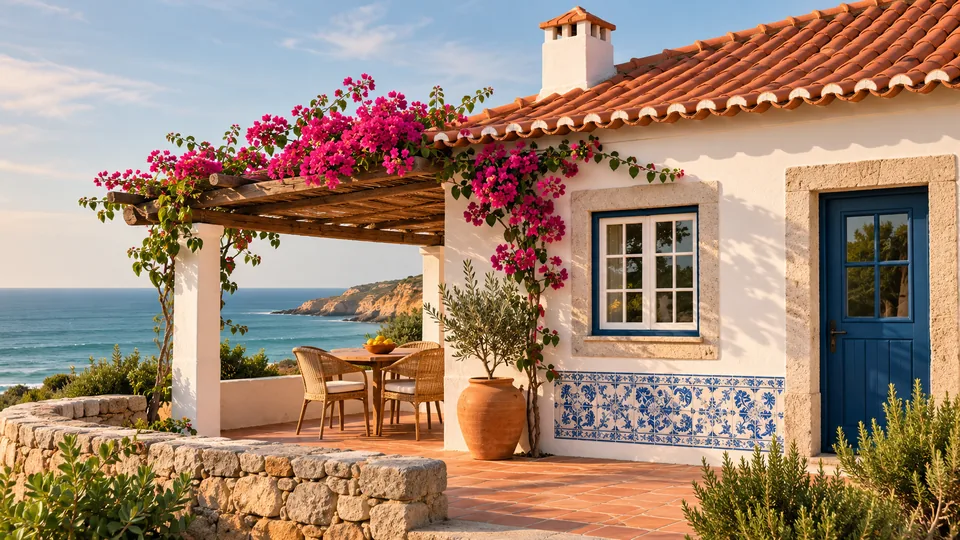
More than a place on the map.
From the first interest in the country,
before choosing a place to live.
Population, dynamics of economy and consumer prices. Indicators refer to specified years; these are statistics of a country or territory, not an estimate of property returns.
Analytics by directionA seasonal guide for the Lisbon area. Average monthly temperatures and precipitation from NASA POWER.
Average precipitation: 1.8…2.1 mm/day.
Average precipitation: 1.0…1.9 mm/day.
Average precipitation: 0.1…0.4 mm/day.
Average precipitation: 0.8…3.1 mm/day.
Ranges of average monthly values for 2001-2025 years: temperature takes into account day and night, precipitation is indicated in mm / day. This is a climate benchmark for a city area, not a forecast or an indicator for the whole country. The NASA POWER data is averaged over a cell around 0,5° × 0,625°; mountains, coasts and other areas may differ.
Several cultural and natural sites from the UNESCO World Heritage List. The links open the official description of each place.
Articles on the topicUNESCO World Heritage Centre / UNESCO DataHub · CC BY-SA 4.0 · Dataset
Leave your phone number. We will discuss your plans and prepare a personal shortlist.
If you have children under 18, they will have to go to school. Schooling in Portugal is compulsory between the ages of six and 18, and the entire education system is managed by two departments. The Ministry of Education (Ministério da Educação) is responsible for primary and secondary education, while the Ministry of Science, Technology and Higher Education (Ministério da Ciência, Tecnologia e Ensino Superior) is responsible for higher education, namely universities and polytechnics.
Children between the ages of three and five can attend preschools. This is not necessary, but it can be a good idea if you want your children to learn Portuguese. Acquaintance with the language at a young age will help in the future to speak it fluently.
When children turn six, they will be required to enroll and attend primary school, which consists of three "cycles" or broad basic education. The first cycle (Ensino Básico – 1°Ciclo) – from the first to the fourth class, the second cycle (Ensino Básico – 2°Ciclo) – from the fifth to the sixth grade, and the third cycle (Ensino Básico – 3°Ciclo) – from the seventh to the eighth grade. After the children have completed the third stage of primary education, they are issued a certificate, a certificate of completion of primary school.
Secondary education continues from 10 to 12 class and gives students a choice of two different variations. They may choose a more academic program or choose a more hands-on path with professional training.
The three-year professional program gives students the skills they need to start working in their chosen field after graduation.
The public school your children will attend depends on where you live, but there are several high-performing public schools in both Porto and Lisbon. The best private schools in the country include the College of Our Lady of the Rosary (Colégio Nossa Senhora do Rosário) in Porto and the College of Manuel Bernardes in Lisbon.
Higher education in Portugal is provided by universities and polytechnic institutes. The difference between almost two teaching positions is that universities deal with more academic subjects, are effective in fields such as mathematics or medicine, while polytechnic institutes require languid professional training in subjects such as business or nursing. As with children’s schools, you can choose both public and private options.
The best universities include both the University of Porto and the University of Lisbon (Universidade de Lisboa).
International schools
There are many international schools in Portugal. This is an alternative if you are looking for a quality education for your children. Most schools match the UK's national curriculum with classes in English, but there are other options depending on what you're looking for. You can also find study programs in the U.S., Germany, France, and the University of Baccalaureate (IB).
Some options for international schools in Lisbon: Astoria International School, St. Julian's and the St. International School. Dominic’s. If you are planning to move to Porto, take a look at the Porto International School.
Portuguese public schools are free from start to finish, but private schools charge as they do everywhere. The amounts can range from 400 to 550 Euros per month. Other costs, such as school meals, school uniforms and admission fees, must also be taken into account.
International schools can be quite expensive as they can set their own fees. They vary by school and class and can range from 6 500 to 22 000 Euros per year.
If you choose a public education system, your children will treat and attend the school closest to your home or job. For registration, you must provide:
Your child’s identity card, passport or certificate from your country’s embassy
Registration form (provided by school) with passport photo
Confirmation of necessary immunizations, vision and hearing tests from the medical center
International schools may have other requirements, such as entrance tests and previous school certificates.
Each region of Portugal has different study hours and holidays, while international schools operate according to the school calendar of their curriculum and the country in which they were founded.
In primary education, children attend school from 09:00 to 15:30. In the second and third stages, their day lasts from 08:45 to 16:45.
The Portuguese school calendar is divided into three semesters, unlike the South African school system, which consists of four semesters.
The exact dates vary, but school classes usually start in mid-September and last until mid-December. After Christmas, the school begins in early January and continues until the Easter holidays (late March to early April). The third semester begins in April and ends at the end of June.
Choosing a public, private or international school depends on your social and financial circumstances. All teaching and classes in both public and private schools will be conducted in Portuguese.
If your children are young, learning Portuguese at school will help them learn the language quickly. In addition, the study program is designed to prepare them for admission to Portuguese universities or polytechnic institutes. If you intend to stay in the country, this may be the best option for a child.
Private schools may cost more, but they have advantages such as smaller classrooms and higher budgets for extracurricular programs. International schools are more expensive and use different international curricula. They provide instruction in English or other languages depending on the school. It can be expensive, but if your child is already halfway through and is not in primary school when you move to Portugal, it may be better to continue learning in a familiar environment.
If you want to enroll your children in a Portuguese public or private school, they will have to learn the language. This can be easy if your children are very young - they will be able to master it themselves, getting into a language environment. But if you have teenagers, that can be a problem. There are many ways to learn Portuguese both in Portugal and abroad, from private tutors to language schools – there are always options.
Thousands of people invest and move to Portugal with their families every year. The excellent residency program for investment combined with a safe, beautiful environment and a high standard of living make Portugal an ideal place to live.
Browse destinations and property listings in the Mavato catalogue.
View propertiesExplore properties for your budget and investment horizon. Discuss potential returns, costs and exit options.
Tell us about your question or plans.

After submitting the form, you will see confirmation that your request has been received.