 Русский
 English
 Español


MAVATO / Oman
A property shortlist in Oman
Leave your phone number. We will discuss your plans and prepare a personal shortlist.
 Sign in / Register
Original published Mavato text. Migrated on 07.11.2026; terms must be checked at the time of enquiry.
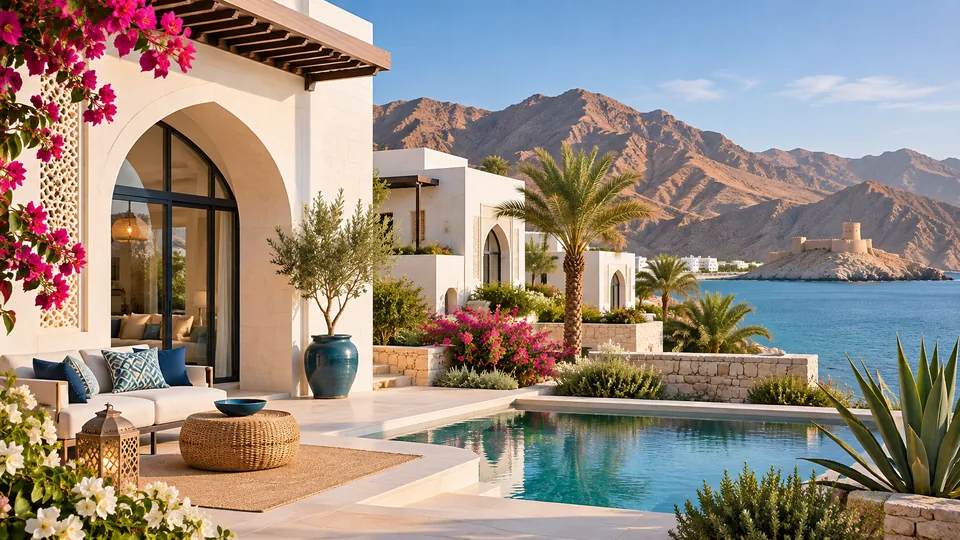
More than a place on the map.
From the first interest in the country,
before choosing a place to live.
Population, dynamics of economy and consumer prices. Indicators refer to specified years; these are statistics of a country or territory, not an estimate of property returns.
Analytics by directionA seasonal guide for the Muscat area. Average monthly temperatures and precipitation from NASA POWER.
Average precipitation: 0.3…0.5 mm/day.
Average precipitation: 0.1…0.6 mm/day.
Average precipitation: 0.2…0.4 mm/day.
Average precipitation: 0.1…0.3 mm/day.
Ranges of average monthly values for 2001-2025 years: temperature takes into account day and night, precipitation is indicated in mm / day. This is a climate benchmark for a city area, not a forecast or an indicator for the whole country. The NASA POWER data is averaged over a cell around 0,5° × 0,625°; mountains, coasts and other areas may differ.
Several cultural and natural sites from the UNESCO World Heritage List. The links open the official description of each place.
Articles on the topicUNESCO World Heritage Centre / UNESCO DataHub · CC BY-SA 4.0 · Dataset
Leave your phone number. We will discuss your plans and prepare a personal shortlist.
When it comes to countries with a high standard of living in the Middle East, Oman is rarely seen by most investors.
However, over the past few years, the country has shown significant progress on many indicators. The question of Oman’s place in terms of living standards is becoming increasingly relevant for those looking for new markets for investment.
Oman's economy is growing steadily, thanks to the sale of oil and gas. At the same time, the country is gradually developing other industries, so as not to depend only on these resources.
For example, tourism: Oman actively attracts tourists, offering cultural and natural attractions such as deserts, mountains, beaches and historical sites. The authorities are investing in the development of hotels, infrastructure and simplify the visa regime for tourists.
Fishing: Oman has a long coastline, which allows for the development of the fishing industry.
Logistics and transport Due to its geographical location, Oman aims to become an important transportation hub between Asia, Africa and Europe. New ports are being built and infrastructure for cargo transportation is being developed.
Mining industry: The country has mineral reserves such as copper, chromium and limestone. Oman is actively developing the extraction and processing of these resources.
Production and agriculture: In recent years, the country has supported the development of local production of goods and agriculture, so as to be less dependent on imports.
On average, each Omani resident earns about $19,000 per year, which is roughly equivalent to the standard of living in neighboring countries. However, unlike countries such as the UAE and Saudi Arabia, where rapid growth and expensive projects, Oman is developing more calmly and balancedly. It attracts those who value stability and security in the country.
In Oman, the most popular professions are related to areas important to the country:
Oil and gas
Construction
Tourism
Healthcare
Teachers
Logistics
The Aichi sphere
Oman is a country with moderate prices and relative affordability.
According to Numbeo at the beginning of 2024, the cost of food in Oman is 52.5% higher than in Russia. Renting housing in Oman is on average 34.3% more expensive than in Russia. The total cost of a basket of goods and services, including food, clothing, transport, communications and utility bills, in Oman is on average 50.5% higher than in Russia.
According to Global Economy, Oman’s 2023 quality of life index for the year was 72 score from 100. This includes indicators of health, education, life expectancy and personal safety.
The country is on 52 place in terms of living standards in the world. For comparison, Saudi Arabia is 48 and Qatar is 35. These data show that Oman, while inferior to some of its neighbors in the region, remains at the top of the global quality of life rankings.
For investors considering Oman as an option for buying property, the relatively low cost of housing compared to neighboring countries is an important factor. The average cost per square meter in Muscat, the capital of Oman, is $2,200, which is significantly lower than, for example, in Dubai ($3,800 per m²).
In addition, the government of Oman is actively promoting foreign investment in real estate through special economic zones and reforms in visa policy, such as the provision of “golden visas” for investors, which creates additional benefits for those who want to buy real estate and obtain a residence permit.
Although Oman does not hold a leading position in terms of living standards in the world, the country is confidently competing with other Gulf states. For investors interested in stability, security and moderate real estate prices, Oman is an interesting and promising market. A stable economy and quality of life make this country one of those that you should pay attention to when planning investments in foreign real estate.
If you are planning to buy property on the Persian Gulf coast, our experts will gladly tell you about the best offers, interesting objects, will choose options in accordance with the budget and desires!
Browse destinations and property listings in the Mavato catalogue.
View propertiesExplore properties for your budget and investment horizon. Discuss potential returns, costs and exit options.
Tell us about your question or plans.

After submitting the form, you will see confirmation that your request has been received.