 Русский
 English
 Español



MAVATO / Montenegro
A property shortlist in Montenegro
Leave your phone number. We will discuss your plans and prepare a personal shortlist.
 Sign in / Register
Original published Mavato text. Migrated on 07.11.2026; terms must be checked at the time of enquiry.
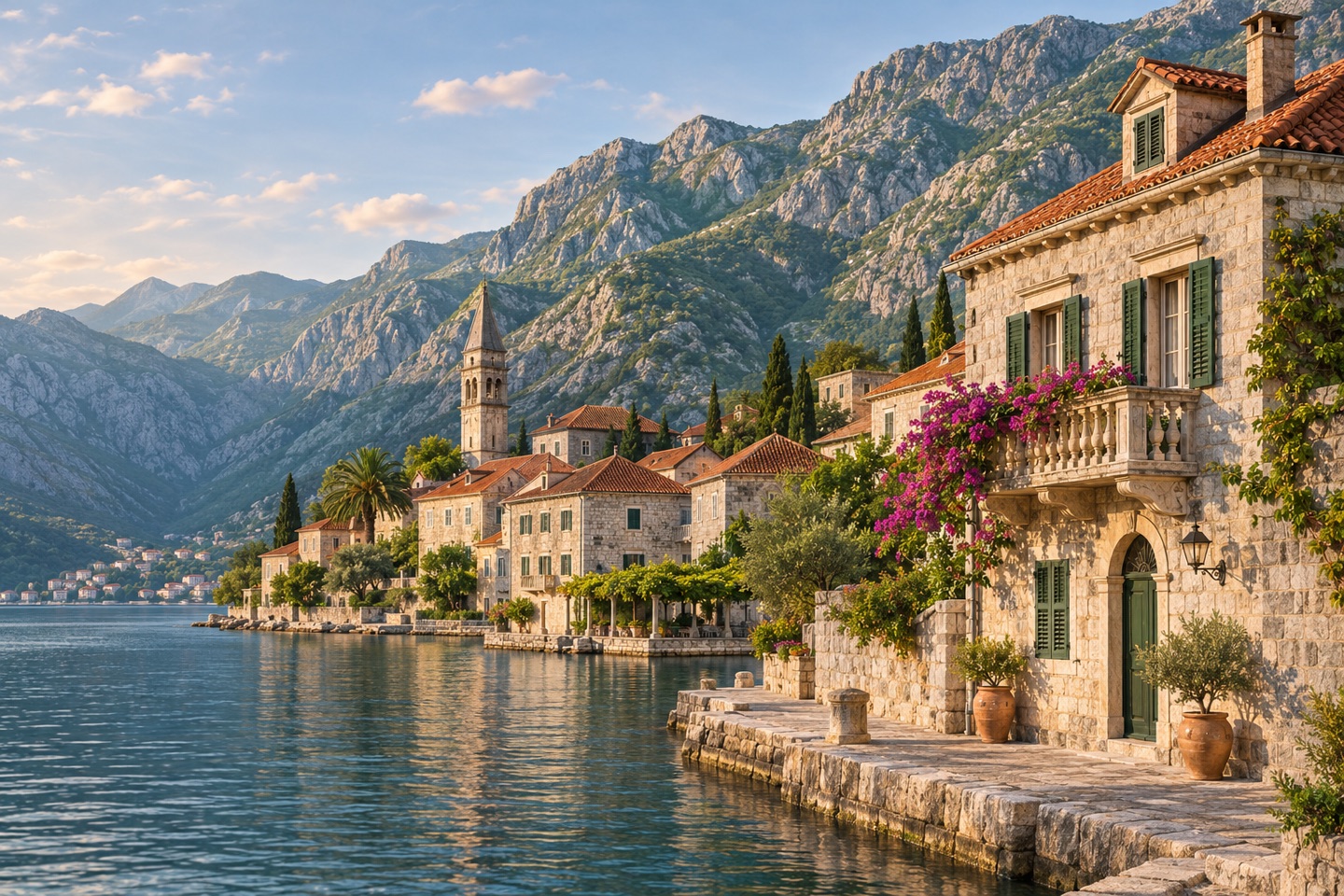
More than a place on the map.
From the first interest in the country,
before choosing a place to live.
Population, dynamics of economy and consumer prices. Indicators refer to specified years; these are statistics of a country or territory, not an estimate of property returns.
Analytics by directionA seasonal guide for the Podgorica area. Average monthly temperatures and precipitation from NASA POWER.
Average precipitation: 5.0…5.7 mm/day.
Average precipitation: 3.0…4.6 mm/day.
Average precipitation: 1.4…2.3 mm/day.
Average precipitation: 3.8…6.5 mm/day.
Ranges of average monthly values for 2001-2025 years: temperature takes into account day and night, precipitation is indicated in mm / day. This is a climate benchmark for a city area, not a forecast or an indicator for the whole country. The NASA POWER data is averaged over a cell around 0,5° × 0,625°; mountains, coasts and other areas may differ.
Several cultural and natural sites from the UNESCO World Heritage List. The links open the official description of each place.
Articles on the topicUNESCO World Heritage Centre / UNESCO DataHub · CC BY-SA 4.0 · Dataset
Leave your phone number. We will discuss your plans and prepare a personal shortlist.
The country has already started the EU accession process, and many world experts expect it to become a full member of the EU by 2025. This shift in status could quickly change the country’s economic status, as Montenegro stands a good chance of becoming one of the world’s leading political and economic superpowers.
But those considering moving to this country need to understand its tax structure to be able to ensure that the financial aspect of their lives is transformed for the better. In this article we will talk about the basics of taxation in Montenegro, consider all the nuances of income, corporate, property taxes, value added tax, withholding, capital gains, inheritance tax and many others.
Two types of income tax should be considered: personal income tax and enterprise income tax.
The personal income tax is levied on the gross income of tax residents of Montenegro. Investment income, employment income, royalties, interest, dividends and other income streams are subject to income tax.
Personal income is taxed at a fixed rate of 9%. The tax rate may be 11%, but it is only levied on any taxable income that exceeds the average income. Montenegro declares its average for each year (approximately 765 euro for 2022), and any income below or equal to the national average is taxed at a fixed rate of 9%, and any additional income above the average is taxed at the rate of 11.%.
To be considered a tax resident and subject to Montenegrin taxes, an individual must be a permanent resident for at least 183 days in a year, tax residents are taxed on regional and world income coming to Montenegro. A non-resident who spends less than 183 days a year is not subject to income tax in Montenegro.
Individual income tax is paid annually, and tax residents must register with local tax authorities. There is a local income tax that must also be paid, and income tax of 13% is paid in all municipalities except Podgorica and Cetinje, where the paid rate is 15%. Local additional taxes are paid directly to the municipality in which it is registered.
Companies and permanent establishments registered in Montenegro are subject to corporate income tax. A permanent establishment is a permanent place of business through which a non-resident carries out its activities in Montenegro.
Corporate tax is levied at a fixed rate of 9% of income. The legislation of Montenegro provides for exceptions for services provided outside the territory of Montenegro, in the case of a double taxation agreement with the country of destination.
Any income in Montenegro is taxable income and a business must register with the tax authorities to guarantee legal taxation of profits from the sale of goods or services. Companies pay income tax annually.
The corporate tax rate in Montenegro is one of the best tax rates in all of Europe, so many companies from different countries flock here to establish their headquarters on Montenegrin soil. Low taxes are vital for any company to remain financially viable, especially for startups. The government of Montenegro understands this and has created an outstanding business environment that will undoubtedly interest any company in opening a branch office here. If Montenegro becomes a member of the EU and retains this corporate tax rate, entrepreneurs and business owners should seriously consider moving their company or even companies to Montenegro to take advantage of low taxes.
Value added tax (VAT) is another financial liability that taxpayers must face in Montenegro. VAT is paid on all goods and services sold within the country. VAT is also paid on the importation of goods.
Any business whose gross turnover (before expenses) is EUR 18 000 or more for one year must pay VAT. However, there are exceptions depending on the type of services or goods sold.
The reduced rate of 7% applies to any goods or services listed below:
Basic commodities such as milk, sugar, bread and butter
Medications and orthopedic or prosthetic instruments;
Educational materials such as textbooks
Accommodation services such as hotels, resorts, motels and other tourist accommodations;
Drinking water, except bottled water;
Public transport services for passengers and their luggage
Public hygiene services;
Ritual services and any goods related to these services;
Copyright
Services related to the use of sports facilities for non-commercial purposes;
Agricultural goods and services
There is even a further reduction of the VAT rate to 0% on services or goods related to the following industries:
Export of goods to foreign countries;
Provision of support services
Services performed with goods imported into Montenegro from abroad
Supply of fuel and other necessary goods used for supply:
Goods and services related to international air or sea transportation;
Goods and services intended for diplomatic and consular representatives
Medications and devices for medical use as determined by the Government
In Montenegro, there is a real estate tax, and this tax depends on the type of real estate, the location of the real estate and the use of the real estate. The average property tax ranges from 0.25% to 1%.
There is also a real estate transfer tax, which applies to real estate and is paid at a tax rate of 3%.
When renting out real estate for financial profit, a real estate rental tax is levied. Property owners who rent out their property are required to pay property tax of 9%. It does not matter whether the rent is monthly or annual, the rental income tax is paid annually based on the total amount of the rent.
Those who rent out monthly and do not rent out all year will still pay tax on the total amount of rental income earned.
Capital gains are taxed at a fixed rate of 9% for both individuals and companies. Capital gains tax in Europe can be quite high, unlike in Montenegro, which makes capital gains tax very attractive for individuals and companies looking to do business in a low tax environment.
Montenegro income tax is paid at the rate of 9%. However, payments of dividends and royalties to non-residents are taxed at a fixed rate of 5%.
There are other indirect taxes that the Montenegrin government requires of its residents. Indirect taxes of Montenegro should be of interest to both individuals and companies within the country, as these taxes may affect their overall income.
The main indirect tax that can affect the costs of a company is customs duties, which apply to foreign goods imported from another country, and can range from 0% to 30% depending on the data on the product, country of origin, purpose. It is crucial to calculate customs duties in the company’s expense column to ensure financial viability. Payment of customs duties is made simultaneously with customs clearance.
Another type of indirect tax that can affect a company’s costs is social security contributions. A company that engages in hiring individuals must contribute to their social security plan as follows:
Retirement and disability insurance: 5.5% of employee’s salary
Health insurance: 2.3%.
Unemployment insurance: 0.5%.
Employees must also pay a part of their salary contribution as follows:
Pension and Disability Insurance: 15%
Health insurance: 8.5%.
Unemployment insurance: 0.5%
The Government of Montenegro has signed double taxation agreements with 43 countries. These countries:
Albania
Austria
Azerbaijan
Belgium
Belarus
Bosnia and Herzegovina
Bulgaria
China
Croatia
Cyprus
Czech Republic
Denmark
Egypt
Finland
France
Germany
Hungary
India
Ireland
Italy
Korea
Kuwait
Latvia
Macedonia
Malaysia
Malta
Moldova
Netherlands
Norway
Poland
Portugal
Romania
Russia
Serbia
Slovak Republic
Slovenia
Sri Lanka
Sweden
Switzerland
Turkey
Ukraine
United Arab Emirates
United Kingdom
Not all countries have the same double taxation agreement, and conditions vary from country to country. However, doing business with any of these countries from Montenegro is made easier by the current double taxation agreement.
Browse destinations and property listings in the Mavato catalogue.
View propertiesExplore properties for your budget and investment horizon. Discuss potential returns, costs and exit options.
Tell us about your question or plans.

After submitting the form, you will see confirmation that your request has been received.