 Русский
 English
 Español


MAVATO / Montenegro
A property shortlist in Montenegro
Leave your phone number. We will discuss your plans and prepare a personal shortlist.
 Sign in / Register
Original published Mavato text. Migrated on 07.11.2026; terms must be checked at the time of enquiry.
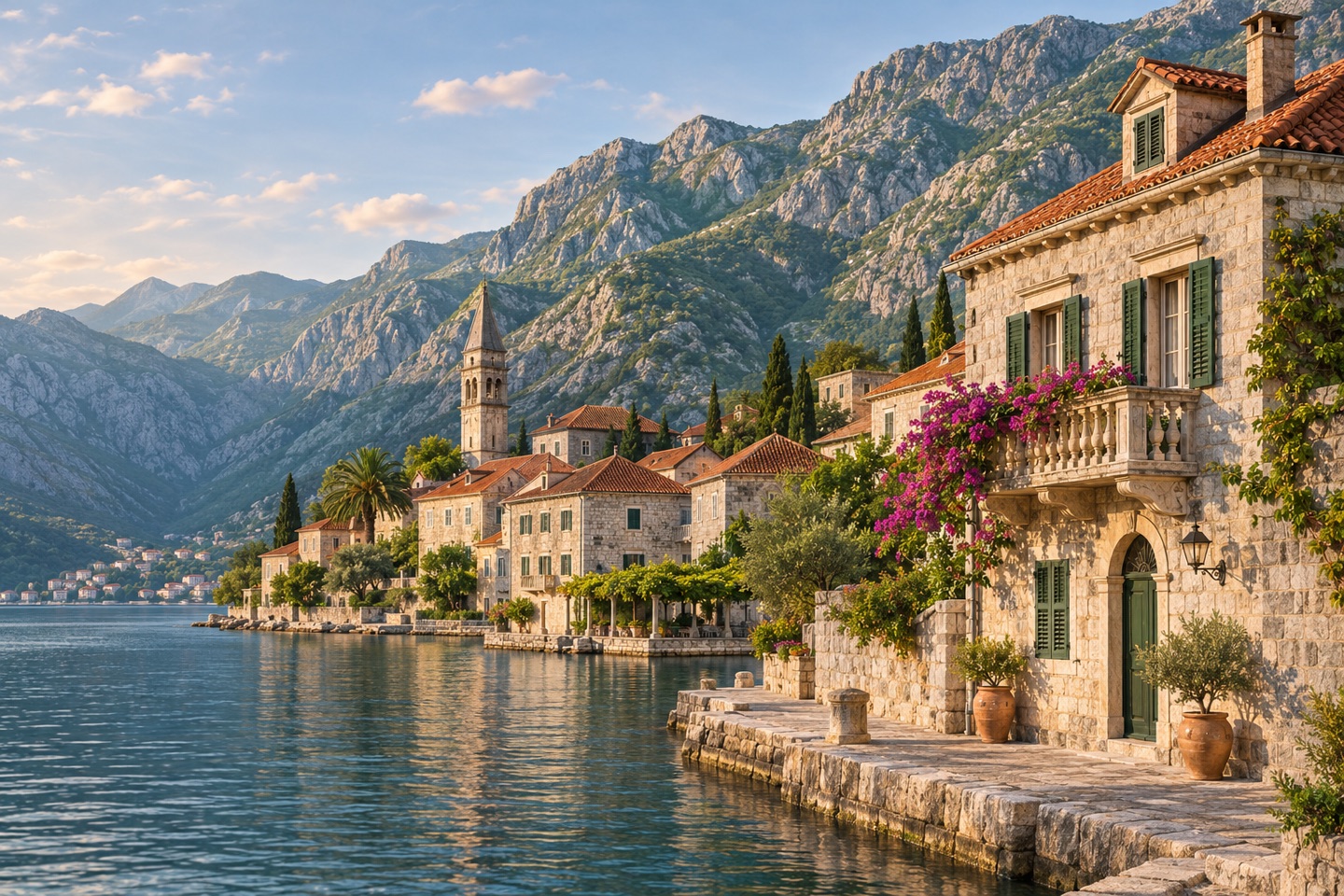
More than a place on the map.
From the first interest in the country,
before choosing a place to live.
Population, dynamics of economy and consumer prices. Indicators refer to specified years; these are statistics of a country or territory, not an estimate of property returns.
Analytics by directionA seasonal guide for the Podgorica area. Average monthly temperatures and precipitation from NASA POWER.
Average precipitation: 5.0…5.7 mm/day.
Average precipitation: 3.0…4.6 mm/day.
Average precipitation: 1.4…2.3 mm/day.
Average precipitation: 3.8…6.5 mm/day.
Ranges of average monthly values for 2001-2025 years: temperature takes into account day and night, precipitation is indicated in mm / day. This is a climate benchmark for a city area, not a forecast or an indicator for the whole country. The NASA POWER data is averaged over a cell around 0,5° × 0,625°; mountains, coasts and other areas may differ.
Several cultural and natural sites from the UNESCO World Heritage List. The links open the official description of each place.
Articles on the topicUNESCO World Heritage Centre / UNESCO DataHub · CC BY-SA 4.0 · Dataset
Leave your phone number. We will discuss your plans and prepare a personal shortlist.
The economy of Montenegro is largely tied to the service sector, in which tourism plays the most important role. The country is a little late with the Industrial Revolution compared to other countries in Europe; due to its mountainous landscape, small population, lack of raw materials and underdeveloped infrastructure, domestic and foreign investment remains at a relatively low level.
The absence of heavy industry has not had a negative impact on the country, and thanks to this factor, Montenegro has become an ecological miracle. It won independence from Serbia in 2006 and is currently a member of the United Nations, the Council of Europe, and a potential candidate for membership of the European Union.
Montenegro is becoming a hub for foreign investment as wealthy Britons and Russians buy property there, which has already led to a cosmopolitan atmosphere as each expat community spreads its own culture in the cities.
The coastal cities have a Mediterranean climate with long hot summers and short mild winters. Inland, the mountains have a more temperate climate with one of the highest rainfall levels in Europe. However, in the winter, between December and the end of March, the rain turns into snow, and skiing is a popular entertainment and tourist attraction.
An important advantage for expats is that foreign nationals need to pay tax only on income earned in Montenegro, unlike the country's citizens themselves, who must pay tax on both domestic and international income.
The healthcare sector in Montenegro, unfortunately, does not boast of high standards, but is constantly improving as the government strives to move closer to the standards of the rest of Western Europe. The health care system is a combination of public and private health care. Medical staff are well-trained professionals, but advanced equipment in hospitals and clinics may be lacking or in short supply.
Therefore, the foreign national must ensure that medical evacuation is included in international health insurance, so that in case of emergency medical care, the patient can be transported to a country that can provide appropriate treatment.
Now that foreign nationals are allowed to buy property in MontenegroThe country is experiencing a boom in this sector. Many buy properties and then decide to move there, while others take advantage of the opportunity to buy homes just for a summer holiday. Buying property is still relatively cheap, with low utility bills and tax breaks. The buying process is simple, as there is very little bureaucracy in the registration process, compared to Germany and other European countries. Buying a home can be done in just two to three days.
Buying a holiday home on the coast is a smart investment as Adriatic tourism is on the rise and property prices are rising with it exponentially.
Shopping in Montenegro contrasts sharply with the bustle of Western European cities. But in some popular markets you can buy fresh fruits and vegetables, fish, cream and cheeses of local production.
Although most stores accept credit cards, it is advisable to always have cash with you to pay small amounts. The cost of living is usually lower than in Western Europe; clothing, utilities, furniture, appliances, groceries, books, movie tickets and meals outside the home are cheaper in Montenegro.
Health care is more expensive compared to other countries, while alcohol, tobacco, public transport, fuel, maintenance and vehicle insurance are generally the same as in the rest of Europe.
For those who are seriously considering moving to Montenegro for permanent residence, numerous expats have created blogs and websites (including ours) that provide a lot of relevant information for anyone who wants to become part of the Balkan state.
Browse destinations and property listings in the Mavato catalogue.
View propertiesExplore properties for your budget and investment horizon. Discuss potential returns, costs and exit options.
Tell us about your question or plans.

After submitting the form, you will see confirmation that your request has been received.