
 Русский
 English
 Español
Buying a new build in Ireland: checking the BER and planning running costs
An energy rating helps compare homes, but it does not replace unit-specific documents, an inspection or a running-cost budget. Follow this practical new-build checklist.

Ireland
More than a place on the map.
From the first interest in the country,
before choosing a place to live.
Population and economy
Population, dynamics of economy and consumer prices. Indicators refer to specified years; these are statistics of a country or territory, not an estimate of property returns.
Analytics by directionSources
- World Bank: Population (2025) 2026-11-09
- World Bank: Growth in Real GDP (2025) 2026-11-09
- World Bank: Inflation (2025) 2026-11-09
- World Bank: GDP per capita (2025) 2026-11-09
Climate · Dublin
A seasonal guide for the Dublin area. Average monthly temperatures and precipitation from NASA POWER.

Winter
December to February ≈ +6…+7 °C Cool · moderate rainfallAverage precipitation: 2.5…3.1 mm/day.
Spring
March-May ≈ +6…+11 °C Cool · moderate rainfallAverage precipitation: 2.0…2.2 mm/day.

Summer
June-August ≈ +14…+15 °C Warm · moderate rainfallAverage precipitation: 2.5…2.9 mm/day.
Autumn
September to November ≈ +8…+14 °C Cool · high rainfallAverage precipitation: 2.5…3.5 mm/day.
Ranges of average monthly values for 2001-2025 years: temperature takes into account day and night, precipitation is indicated in mm / day. This is a climate benchmark for a city area, not a forecast or an indicator for the whole country. The NASA POWER data is averaged over a cell around 0,5° × 0,625°; mountains, coasts and other areas may differ.
Sources
Places and heritage
Several cultural and natural sites from the UNESCO World Heritage List. The links open the official description of each place.
Articles on the topicSources
- UNESCO: Brú na Bóinne - Archaeological Ensemble of the Bend of the Boyne 2026-11-09
- UNESCO: Sceilg Mhichíl 2026-11-09
UNESCO World Heritage Centre / UNESCO DataHub · CC BY-SA 4.0 · Dataset
A property shortlist in Ireland
Leave your phone number. We will discuss your plans and prepare a personal shortlist.
An energy rating in an Irish new-build advertisement can look like a complete answer about future running costs. For a buyer, it is only a starting point. Establish which home the document covers, when it was assessed and what will actually be handed over with the keys. A label in a brochure does not explain the heating controls, equipment servicing or the full cost of ownership.
First identify the certificate you have
SEAI distinguishes a provisional BER for an off-plan sale from the assessment of a completed home. The provisional certificate uses design information and is valid for two years. A new-final BER follows construction and includes a survey. The design rating is therefore not a survey of finished work.[1]
Keep a folder for the exact apartment or house number. Include the plan, specification, current certificate and correspondence about final documents. If you switch floors, layouts or buildings, review the package again. Information about a neighbouring unit may help explain the development but must not silently replace information about the home you are buying.
Account for the 2026 rating-scale change
The scale changed on 24 May 2026 to A0, A, B, C, D, E, F and G, replacing the former subdivisions. Earlier certificates remain valid subject to the applicable conditions. Different old and new labels do not by themselves prove an error: check the issue dates first.[2] [3]
Record the label exactly as it appears on the certificate, with its date and assessment type alongside it. Do not rewrite ratings to make advertisements easier to compare. Archive an earlier certificate when a replacement arrives and ask why it changed. This helps distinguish design revisions, equipment substitutions and a change in the document format.
Check the record and read the accompanying report
The SEAI register can be searched using a BER number or MPRN. It provides the certificate and expiry information. The accompanying Advisory Report explains potential improvements. Save the files rather than only a screenshot of the rating in an advertisement.[4] [5]
If the postal address is still being established, ask the seller to link the construction reference, postal address and certificate in writing. A mismatch should be resolved before you rely on the information, rather than automatically treated as wrongdoing. Ask the assessor about the calculation itself instead of trying to infer the answer from the development’s sales description.
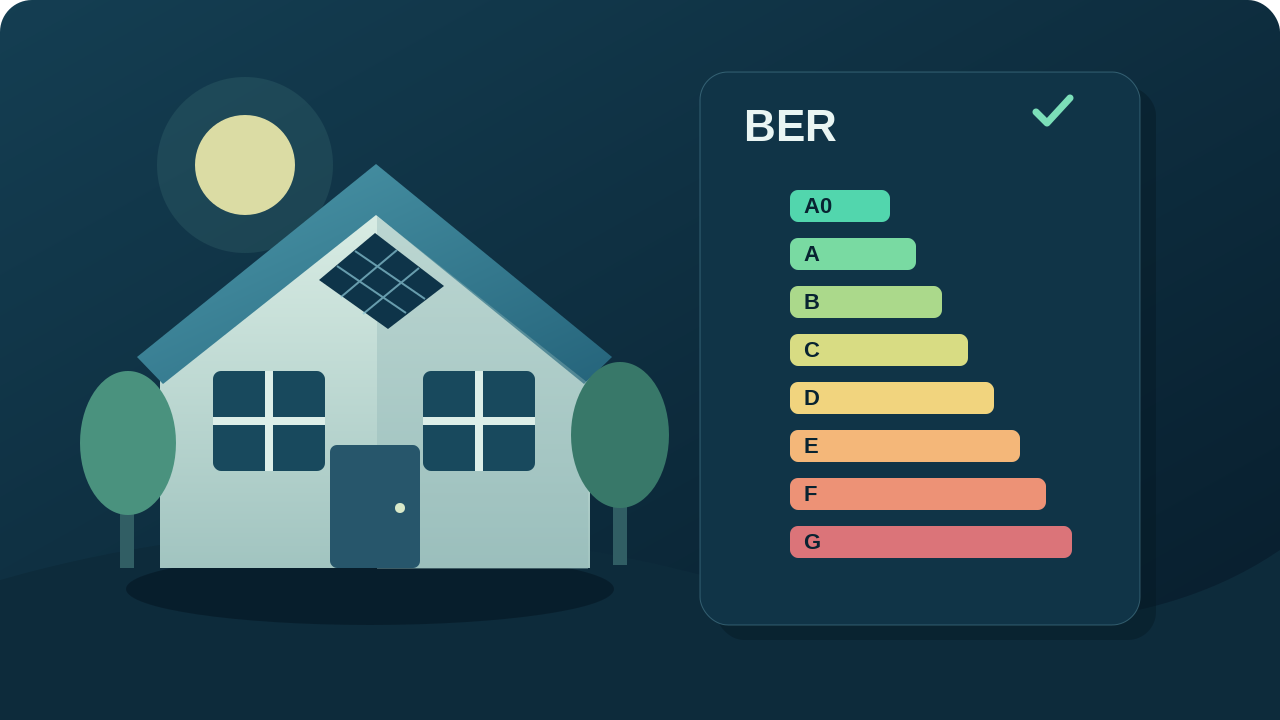
The rating and your energy bill answer different questions
A BER uses standardised assumptions about building use. Actual expenditure also depends on your habits, tariff and appliance use. A rating cannot therefore be converted directly into a promised monthly bill. Compare two homes using consistent assumptions and a separate expense calculation.[6]
Ask which systems serve your unit and which serve the entire building. For an apartment, check whether any energy costs are included in the service charge. Separate energy-supplier bills, engineering-system maintenance and other development expenses. More efficient heating should not obscure other recurring charges that matter just as much to your household budget.
| Handover question | What to keep in your file |
|---|---|
| How are heating and ventilation controlled? | Manuals and a record of the controls demonstration |
| Who services the equipment? | Contacts, intervals and servicing terms |
| How is the unit linked to the certificate? | Address, unit number and current certificate |
| Which recurring charges are separate? | Written breakdown of development charges |
An inspection complements the documents
At handover, ask for a demonstration of heating start-up, temperature controls, ventilation modes and any user-accessible filters. Do not alter technical settings you do not understand. Record questions and agree who will answer them after moving in. A practical demonstration is more useful than a general assurance that a modern home runs automatically, especially if its heating system is unfamiliar.
Arrange a separate condition inspection and snagging record. The energy document does not replace observations about finishes, supplied items or equipment operation. Separate documentation questions, control-setting questions and workmanship issues. For each, retain photographs, the responsible contact and the agreed response process; keep the correspondence after collecting the keys.
Turn the checks into a property comparison
Compare shortlisted homes using one form: purchase price, completion stage, documents, equipment, confirmed recurring charges and unanswered questions. Do not select a winner on a letter alone. Layout, daylight, commuting and everyday services matter too. A sound choice meets your documentation, lifestyle and budget needs together, rather than merely winning a comparison of promotional photographs.
Give your consultant this checklist along with the city, bedroom count and preferred moving date. Ask for confirmed information in the shortlist, with outstanding seller enquiries marked separately. Irish new-build offers then become easier to compare, and the next discussion can focus on specific purchase conditions instead of an attractive development name.
Explore property in Ireland and request a shortlist matching your requirements.
Sources and periods of data
- SEAI — provisional and final BER Accessed: 2026-11-18
- SEAI — new BER scale Accessed: 2026-11-18
- Government of Ireland — certificates after the scale change Accessed: 2026-11-18
- SEAI — BER certificate register Accessed: 2026-11-18
- SEAI — advisory report Accessed: 2026-11-18
- SEAI — understanding an energy rating Accessed: 2026-11-18
