 Русский
 English
 Español


MAVATO / Indonesia
A property shortlist in Indonesia
Leave your phone number. We will discuss your plans and prepare a personal shortlist.
 Sign in / Register
Original published Mavato text. Migrated on 07.11.2026; terms must be checked at the time of enquiry.
More than a place on the map.
From the first interest in the country,
before choosing a place to live.
Population, dynamics of economy and consumer prices. Indicators refer to specified years; these are statistics of a country or territory, not an estimate of property returns.
Analytics by directionA seasonal landmark for the Jakarta city district. Average monthly temperatures and precipitation according to NASA POWER.
Average precipitation: 1.6…3.2 mm/day.
Average precipitation: 2.2…6.6 mm/day.
Average precipitation: 7.9…13.7 mm/day.
Average precipitation: 4.6…8.0 mm/day.
Ranges of average monthly values for 2001-2025 years: temperature takes into account day and night, precipitation is indicated in mm / day. This is a climate benchmark for a city area, not a forecast or an indicator for the whole country. Season names are conditional: these are calendar groups of months, not the boundaries of the dry or rainy season. The NASA POWER data is averaged over a cell around 0,5° × 0,625°; mountains, coasts and other areas may differ.
Several cultural and natural sites from the UNESCO World Heritage List. The links open the official description of each place.
Articles on the topicUNESCO World Heritage Centre / UNESCO DataHub · CC BY-SA 4.0 · Dataset
Leave your phone number. We will discuss your plans and prepare a personal shortlist.
Despite its small size, nature on the island of Bali is very rich and diverse. Volcanoes, beaches and reefs are just some of the outstanding features of the natural landscape. Along with this, Bali has a very rich world of fauna: from simple ducks in rice fields to the rarest species of birds. The environment is one of the island’s problems.
Bali It is a small island that makes up the Indonesian archipelago. It is adjacent to the most populous island of Java and, directly, to the west of the chain of small islands that make up Nusa Tenggara, which includes Lombok.
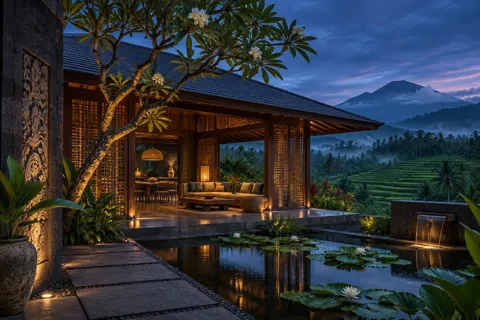
The views of the island are impressive: a mountain range with a string of active volcanoes and several peaks at an altitude of about 2000 meters. Agricultural land in Bali is located both south and north of the central mountains. The southern region is a wide, gentle area where most of the country's abundant rice crops are grown. The northern coastal strip is narrower and quickly rises to the foothills of the central ridge. Less rain falls here, but coffee, copra, rice and cattle are grown here. Bali also has beaches of various shapes and colors. From hidden coves and secluded beaches to noisy with pearl white sand, and there is even a beach with sparkling black sand.
The arid, less populated areas of Bali include the western mountainous region as well as the eastern and northeastern slopes of Gunung Agung. The islands of Nusa Penida are arid and cannot be grown intensively. The Bukit Peninsula is also arid, but with the growth of tourism, it has become very densely populated.
Bali is volcanically active and extremely fertile. The two phenomena go hand in hand, as eruptions contribute to the exceptional fertility of the land, and the high mountains provide reliable rain irrigation to the island of Bali. Of course, volcanoes are a danger too - Bali has experienced catastrophic eruptions in the past, such as in 1963, and no doubt they will recur again in the future. Gunung Agung, the "mother mountain", the height of 3142 meters, is covered with dense forest on the south side.
When traveling in Indonesia, take care of the nature around you.
Watch how you use the water. Water demand is outstripping supply across much of Indonesia - even in seemingly green places like Bali. Take advantage of your hotel's offer to save water by not washing sheets and towels every day. You can also give up your own small pool or the pool as a whole.
Do not buy water in plastic bottles. These bottles are convenient, but the millions of such bottles thrown away each year pose a serious environmental hazard.
In Indonesia, the number of enterprises that adhere to the best practices of environmental protection is growing rapidly.
A fast-growing population, limited resources, external pressures, and weak and sometimes non-existent environmental regulations mean that Bali is under great threat. And some of Bali's environmental problems are bigger than the island itself: climate change is causing water levels to rise, damaging the coast and beaches.
Meanwhile, Bali’s fast-growing population is consuming too many limited resources. The tourism industry is attracting new residents, and there has been a rapid growth of urban areas, resorts and villas that are invading farmland.
The use of water is a serious problem. Typical top-end hotels use from 1000 to 1500 litres of water per room per day, and the growing number of golf courses – for example, on the arid Bukit Peninsula in the Pekatu Indus area and in Nusa Dua – is greatly increasing the already huge consumption of resources. Many of the huge new resorts on Bukita's south coast are also massive water consumers.
Water pollution. A serious problem caused both by deforestation caused by the collection of firewood in the mountains and by the lack of proper treatment of waste produced by the local population. The streams that flow into the ocean at popular locations, such as the Double Six Beach in Legian, are highly polluted, often by sewage from hotels. The vast mangroves along the southern coast near Benoa Harbour are losing the ability to filter the water flowing here from most of the island and are themselves under threat.
Air pollution. Anyone stuck behind a smoking truck or bus on one of the main roads knows that the air in southern Bali is often smoky. A view of south Bali from a hillside shows a brown blanket hanging in the air that could compare to Los Angeles in the 1960s.
Waste. The problem is not only plastic bags and water bottles, but also the huge amount of waste produced by the population - what to do with them? Balinese people look sadly at the vast amount of waste, especially plastic, that has accumulated in their once clean rivers.
On the positive side, there are new opportunities to grow rice and other foods through organic means. The sewage treatment program in the south operates in certain areas, although some enterprises still refuse to join the program, objecting to the cost of excess costs.
In Pemuteran, reef cultivation programs have been widely accepted. This is important because a World Wildlife Fund study found that less than 5% of Bali’s reefs were completely healthy.
Browse destinations and property listings in the Mavato catalogue.
View propertiesExplore properties for your budget and investment horizon. Discuss potential returns, costs and exit options.
Tell us about your question or plans.

After submitting the form, you will see confirmation that your request has been received.