 Русский
 English
 Español



MAVATO / Argentina
A property shortlist in Argentina
Leave your phone number. We will discuss your plans and prepare a personal shortlist.
 Sign in / Register
Original published Mavato text. Migrated on 07.11.2026; terms must be checked at the time of enquiry.
More than a place on the map.
From the first interest in the country,
before choosing a place to live.
Population, dynamics of economy and consumer prices. Indicators refer to specified years; these are statistics of a country or territory, not an estimate of property returns.
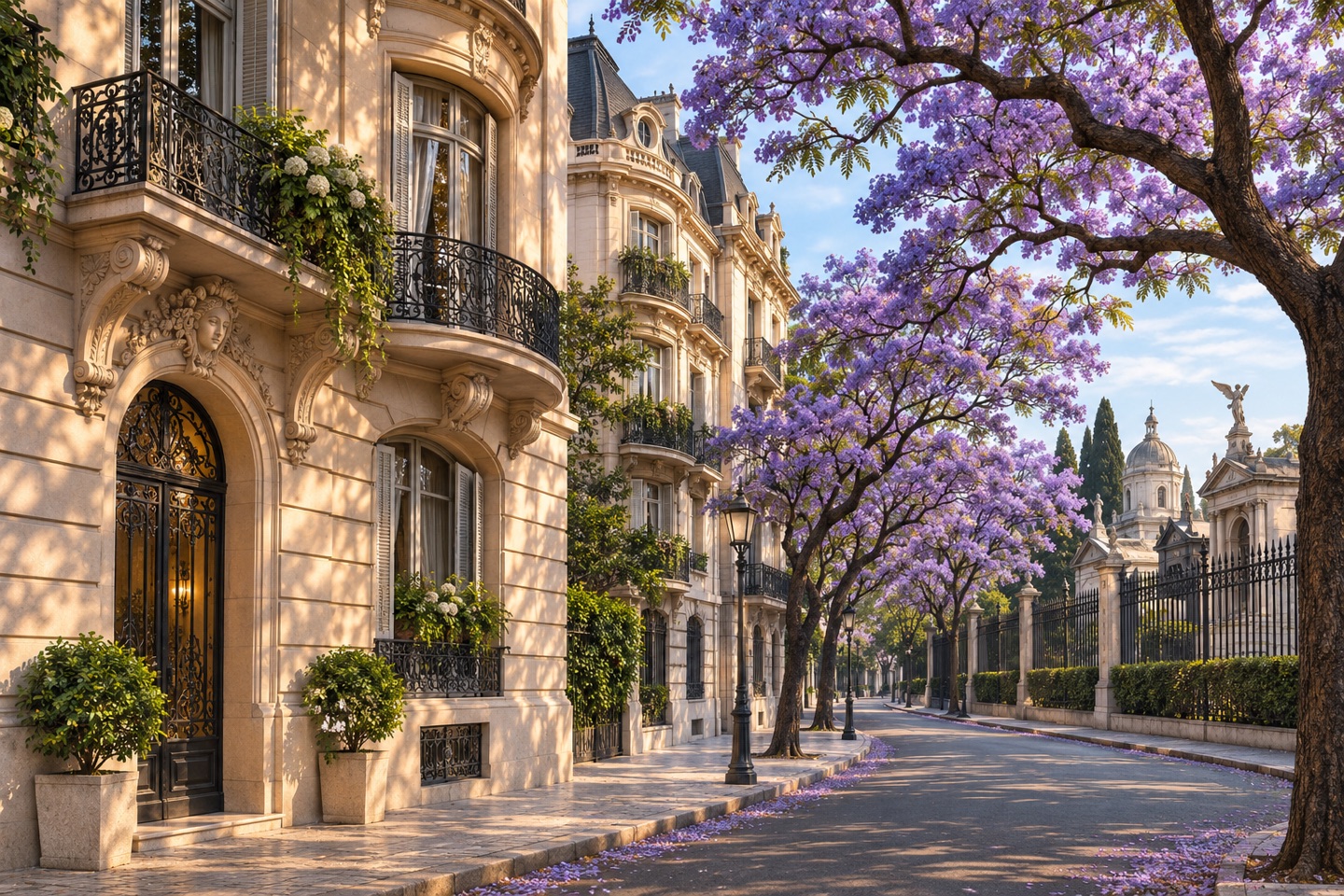
Analytics by directionA seasonal landmark for the city of Buenos Aires. Average monthly temperatures and precipitation according to NASA POWER.
Average precipitation: 1.8…2.3 mm/day.
Average precipitation: 2.8…3.5 mm/day.
Average precipitation: 3.0…4.3 mm/day.
Average precipitation: 2.4…4.0 mm/day.
Ranges of average monthly values for 2001-2025 years: temperature takes into account day and night, precipitation is indicated in mm / day. This is a climate benchmark for a city area, not a forecast or an indicator for the whole country. Seasons are indicated for the Southern Hemisphere. The NASA POWER data is averaged over a cell around 0,5° × 0,625°; mountains, coasts and other areas may differ.
Several cultural and natural sites from the UNESCO World Heritage List. The links open the official description of each place.
Articles on the topicUNESCO World Heritage Centre / UNESCO DataHub · CC BY-SA 4.0 · Dataset
Leave your phone number. We will discuss your plans and prepare a personal shortlist.
The school year in Argentina starts in March and ends in December, and lasts about 200 days. Schools are closed for national holidays such as Good Friday and Easter, and for two weeks in July for holidays. Generally, in public elementary schools, classes take place four and a half hours every weekday. Saturdays are usually reserved for extracurricular school activities. Often, the school has morning and afternoon classes, which allows students and teachers to choose the time of classes. Some primary schools offer evening classes for adults. Bilingual programs are offered in many private primary schools.
The education system is divided into four separate levels. Preschool level (kindergarten) is optional and educates children aged from 3 to 5 years. The initial (elementary) level is mandatory and consists of 7 classes. Pupils at this level must remain until the completion of all 7 classes or, in the event of a lag for any reason of class repetition, until the 14 years. Children aged from 6 to 12 years attend primary school with adults in need of education at this level. The average level is attended by young people aged 12 to 17 years or 16 years if they work and attend evening school. Courses range from 3 to 8 years and prepare students for professional programs. Higher education includes private and national universities and institutions that provide teacher training and technical skills development.
University education is provided by public universities, national or provincial, and private universities. Since the 1955, university admission is open to all students who have graduated from high school. Some public universities, such as the University of Buenos Aires, require an introductory course or an entrance exam, or both, and many private universities require their own entrance exams. A traditional university degree is awarded after five or six years of full-time study in a specialized field. Degrees can be obtained for completing part of the program or for completing a program of study that allows the holder of the degree to work in a particular profession. The academic year usually consists of two, four-month semesters, and full-time students usually attend three classes per semester of six hours per week. The main method of teaching remains lecturing.
The academic year begins in March and ends in December, although the calendar may vary slightly from one faculty to another within the university. A typical university consists of independent majors in a specific field, such as law or agriculture, and these faculties are free to change their assessment system, calendar, and academic hours. Universities develop their own degree curricula and programs, but they are approved by the National University Administration. Universities communicate with each other through the National Interuniversity Council, one for public and the other for private universities, both consisting of university rectors (presidents). Student unions also influence university politics, but neither rector committees nor student unions have official authority over universities.
Pre-school education
Preschool education is not compulsory in Argentina, but since the 1980s, preschool enrolment has grown rapidly. Most preschools are private and cater to children from the upper strata of society. By 1986, Argentina had little more than 8000 preschools. According to the government, preschool education should prepare the child physically, spiritually and morally, as well as instill the right habits and teach obedience. The child learns personal hygiene along with proper posture and elegant movements, gets acquainted with language skills, arithmetic, writing and reading. Religion is also part of a child’s education.
In Argentina, education is highly valued at all levels and is compulsory for all children aged from 6 to 18 years. It includes both public schools, which are maintained and funded by the state and are free to attend, and private schools, which are usually run by churches or other non-profit associations. The size of enrolment at each of these schools varies depending on the location of the school. For example, schools in major Argentine cities such as Buenos Aires may have many classrooms, while schools in the regions and rural areas - schools in which many pupils have to ride horses just to attend them - may consist of only one or two classrooms.
The emphasis and commitment to education in Argentina is evident in the country's high literacy rate - 95 percent - and the number of university graduates per capita - 3,2 percent of the population. Both of these statistics are very high compared to all other countries in South America.
Primary school in Argentina is compulsory for all students between the ages of 6 and 14, regardless of which part of the country they live in. As mentioned, primary school can be attended free of charge; however, there are certain costs that must be paid, including certain books, study materials and school uniforms, which for all students consists of a white coat reminiscent of the one worn by doctors and scientists in the laboratory, and is widely regarded as a symbol of learning in Argentina.
The primary school curriculum is very similar to that of other countries. Students study a wide range of subjects including natural sciences, mathematics, literature, art, history, sports and geography. There are also certain classrooms and schools that cater to students with special needs and disabilities - physical, mental or emotional difficulties - that create barriers to learning in traditional classrooms.
Although public high schools in Argentina are also free, education at this level was not even mandatory by law until 2007, which sadly means that there have been generations of pupils who have missed out on the offers students enjoy today. Studies show that before 2007, only half of all primary school students were still in high school, and most came from more urban and affluent areas of the country. Unfortunately, the rationale behind these statistics has more to do with economics than with lack of interest. Many middle-aged students, especially those from low-income families, had to drop out of school early to earn money to support themselves and their families.
Today, education in high school is compulsory, and in Argentina these schools are called polymodal, meaning students have a choice in terms of the type or "modile" of curriculum they can study. As a rule, studies at this level last 5 years and are divided into three different types of programs: Bachelor’s degree, commercial schools and Escuelas Tecnicas. Bachelor’s programs focus on the humanities, including language, history, grammar and social science courses. Commercial schools focus on economic sciences including business, accounting, and household, while the latter type, Escuelas Tecnicas, delves into the technical and applied sciences including computers, information systems, and chemistry.
Universities can award various degrees. The short-term degree program, which takes two or three years, trains the student to specialize in a specific field, such as computer programming or library science. An intermediate degree takes three years and entitles you to immediate employment in a particular profession or to continue for another two years and obtain a license in a particular field.
As with other degree programs, each university determines the duration of the program and the curriculum. A medical degree ranges from five to seven years, depending on the specialization. Some universities require seven years of study to obtain the same degree that others award in five years. Although most universities require students to take their courses in a prescribed sequence, those who receive a degree are eligible to practice in their field of study, such as law, medicine, or engineering.
Since the 1980-ies, the number of master’s degree programs has increased, and they include master’s degrees along with doctoral degrees. The emphasis remains on preparation for a particular profession rather than original research, and only about 7% receive postgraduate education, as the degree entitles them to work in a profession without it. However, universities are increasingly requiring that all candidates for professors hold a doctorate, and many professions are giving additional importance to academic degrees. The National Office of Universities approves a degree, but no central authority nationally oversees graduate programs, so standards vary considerably across universities. Doctoral programs usually include coursework and a dissertation that brings new knowledge to the field of study.
There is a wide gap between urban and rural schools. Many provinces are geographically isolated, and almost 50 percent of the country's population resides in metropolitan Buenos Aires, leaving rural areas with very few opportunities. Consequently, the level of education in rural areas is lower. Overall, however, many improvements have been made in 1983 since the restoration of a democratic government. Rural education has been expanded, more 17 000 adult schools have been built, and hundreds of secondary schools offer evening classes for working people.
Browse destinations and property listings in the Mavato catalogue.
View propertiesExplore properties for your budget and investment horizon. Discuss potential returns, costs and exit options.
Tell us about your question or plans.

After submitting the form, you will see confirmation that your request has been received.