
 Русский
 English
 Español
Portugal house prices and income: reading the data and checking your budget
A national index describes market changes, not the apartment an individual household can afford. Turn the affordability discussion into clear budget entries.

Portugal
More than a place on the map.
From the first interest in the country,
before choosing a place to live.
Population and economy
Population, dynamics of economy and consumer prices. Indicators refer to specified years; these are statistics of a country or territory, not an estimate of property returns.
Analytics by directionSources
- World Bank: Population (2025) 2026-11-09
- World Bank: Growth in Real GDP (2025) 2026-11-09
- World Bank: Inflation (2025) 2026-11-09
- World Bank: GDP per capita (2025) 2026-11-09
Climate · Lisbon
A seasonal guide for the Lisbon area. Average monthly temperatures and precipitation from NASA POWER.

Winter
December to February ≈ +13…+14 °C Warm · moderate rainfallAverage precipitation: 1.8…2.1 mm/day.
Spring
March-May ≈ +14…+17 °C Warm · moderate rainfallAverage precipitation: 1.0…1.9 mm/day.
Summer
June-August ≈ +19…+20 °C Warm · low rainfallAverage precipitation: 0.1…0.4 mm/day.
Autumn
September to November ≈ +16…+20 °C Warm · moderate rainfallAverage precipitation: 0.8…3.1 mm/day.
Ranges of average monthly values for 2001-2025 years: temperature takes into account day and night, precipitation is indicated in mm / day. This is a climate benchmark for a city area, not a forecast or an indicator for the whole country. The NASA POWER data is averaged over a cell around 0,5° × 0,625°; mountains, coasts and other areas may differ.
Sources
Places and heritage
Several cultural and natural sites from the UNESCO World Heritage List. The links open the official description of each place.
Articles on the topicSources
- UNESCO: Central Zone of the Town of Angra do Heroismo in the Azores 2026-11-09
- UNESCO: Monastery of the Hieronymites and Tower of Belém in Lisbon 2026-11-09
- UNESCO: Monastery of Batalha 2026-11-09
UNESCO World Heritage Centre / UNESCO DataHub · CC BY-SA 4.0 · Dataset
A property shortlist in Portugal
Leave your phone number. We will discuss your plans and prepare a personal shortlist.
When choosing property in Portugal, it is easy to debate whether housing has become more expensive without calculating your own purchase. Some people compare prices, others wages or monthly payments. These measures answer different questions. Start with what you need to know: cash required before collecting the keys, the recurring cost your household can sustain and the money left for unexpected events.
What the latest index actually says
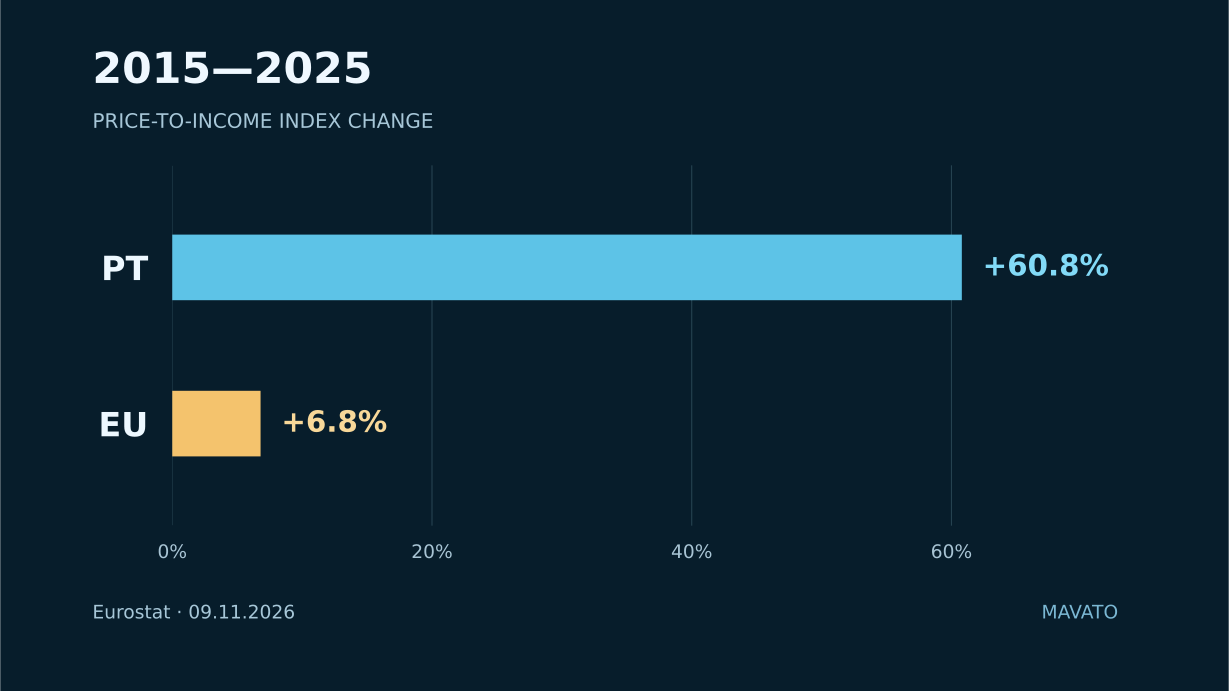
Eurostat reported on 9 November 2026 that the house price-to-income ratio increased by 60.8% in Portugal and 6.8% in the EU over 2015–2025. This is an index change, not an apartment price or the number of annual salaries needed to buy one.[1]
The practical conclusion is limited: national trends provide context, while an individual decision needs information about the home and household. Multiplying today’s budget by the index change will not produce a correct purchase price. Nor should every neighbourhood be assumed to have moved equally. Compare actual offers with similar sizes, condition, locations and included features.
Divide your savings before choosing a home
For an initial calculation, split savings between the purchase itself, related costs and a reserve. Do not treat the entire bank balance as a down payment. Some funds may be needed for the transaction, moving, furnishing or temporary accommodation. Costs depend on the deal: request an individual estimate instead of applying a universal percentage from somebody else’s purchase.
Give the reserve a defined purpose too. Separate money for planned furniture from funds for an income delay or unexpected repair. If the same balance is both an emergency reserve and the kitchen budget, the calculation already overstates what the household can afford. Remove this double counting before considering a more expensive home or raising an offer.
Worked example: the same savings, different purchases
Consider an educational example, not a real transaction, bank offer or statement of current taxes. A household has €70,000 in savings, provisionally sets aside €15,000 for related costs and keeps another €15,000 as a reserve. That leaves €40,000 towards the property price. A €200,000 home leaves a €160,000 funding gap; a €250,000 home leaves a €210,000 gap.
Two illustrative purchase budgets, not bank offers
| Line of calculation | Option A | Option B |
|---|---|---|
| Illustrative property price | 200 000 € | 250 000 € |
| Savings before purchase | 70 000 € | 70 000 € |
| Illustrative costs, to be confirmed for the deal | 15 000 € | 15 000 € |
| Reserve after purchase | 15 000 € | 15 000 € |
| Own funds towards the price | 40 000 € | 40 000 € |
| Funding still required | 160 000 € | 210 000 € |
The funding gap is not an approved loan. Availability and financing terms must be established separately. The point here is that a €50,000 price increase raises the external funding requirement by the same amount because savings and reserves stay unchanged. If the dearer option quietly removes the reserve, it is a different scenario and should be shown explicitly.
Compare monthly costs on the same basis
Now suppose stable household income after mandatory deductions is €3,000 a month. Two illustrative budgets have total monthly housing costs of €950 and €1,200. These represent approximately 31.7% and 40% of that income. Neither is presented as a safe threshold or bank rule; this is simply housing cost divided by income to compare scenarios.
For a useful comparison, both columns must contain the same categories. A loan payment alone cannot be compared fairly with a figure including building charges, insurance and other recurring costs. Convert amounts to a consistent monthly basis, separate one-off costs and mark confirmed values versus estimates. An unverified estimate should not become a supposedly precise figure just to tidy the table.
Compare locations through the remaining budget
Everyday needs still have to be paid after housing. A cheaper home far from regular journeys may add transport costs, while less space may create a need for separate workspace or storage. Map an ordinary week and test each option against it. Comparing Lisbon, Porto or another city then reflects your life instead of the destination’s reputation alone.
Before requesting a shortlist, prepare a brief: purchase purpose, cities, available funds, protected reserve, desired monthly cost and housing requirements. Add questions still needing confirmation from a bank, transaction adviser or seller. This helps your consultant select suitable options and explain trade-offs. The national index supplies context; the decision rests on verified details of the individual property.
Browse property in Portugal or request a shortlist for your budget using the form on this page.
Sources and periods of data
- Eurostat — house price-to-income ratio Reference period: 2015–2025: change in the price-to-income ratio · Source date: 2026-11-09 · Accessed: 2026-11-18
